Blog

Humility; enabling the entry of values and ethics in policy making

(In memory of Andrew Janisch)

A key principle of complexity is that of ‘incompressibility’. Complexity cannot be reduced or simplified, any attempt to do so loses something. Further, there is no such thing as an objective observer in generalised complexity thinking, each perspective is significant, unique, partial and provisional.

A search for ‘the truth’ and certainty in complexity then becomes an asymptotic exercise; a universal truth is inherently undiscoverable. Acknowledging this from the perspective of a modernist paradigm steeped in the late twentieth century triumph of science and reduction requires humility, and a recognition of the importance of perspective.

From here, identifying the limits to knowledge and certainty may become more productive than continuing to invest in more data, more evidence. So too, exploring the ‘technologies of humility’, as described by Jasanoff in an essay in Nature, 2007.   How to proceed under certain uncertainty.

The importance of values; understanding who values what and why, is highlighted. An ethical dimension enters as basis for policymaking. In many instances it may be more important to act now, ethically, than to wait for more certainty.

Others write of humility in relation to disciplinary knowledge and tools, especially models, a central feature of climate mitigation policy work. Academic disciplines have developed and engaged with different ways of knowing, but all perspectives are partial.  Humble collaboration with a respect for difference is required in the face of complexity. A curiosity for perspectives and different values can unlock many ‘spaces of the possible’ (Shine, 2015).

I recall a brief engagement I had with Andrew a good many years ago now on a model for financing a solar water heater programme in low income communities which I had developeAndrew-Janischd and he had advanced. I approached the meeting proud of my output and fully bought-into an epistemology that maintained the superiority of such tools. I recall our discussion well – I was thoroughly confused at his refusal to join me in my inflated view of the cleverness and utility of the model, despite his having made some excellent improvements to it. He was utterly humble in both its role, and his role, in advancing the objectives of the programme. And in retrospect a whole lot more realistic.

This experience of Andrew’s humility and its implications for our practice has been long lasting, and will always remain an inspiration to me as I know it is to others. He will be sorely missed.


Brexit – a complexity take

Like the world at large I’m still reeling from the Brexit result. As I’ve listened and watched and read the flurry of commentary I find myself wondering what insights complexity thinking can offer on how Brexit occurred, how to evaluate the result and its implications.

The Brexit vote could be characterised as a non-linear, largely unexpected event, perhaps even by the Leave campaign itself and some of its supporters. Certainly the UK’s political leadership seems to have been caught by surprise. Would paying closer attention to the emergent patterning of voter sentiment and the political system itself have given them pause to consider more carefully what they unleashed?   Complexity thinking warns against simple actions as ‘solutions’ to complex problems. This, of everything, should have acted as a red flag for politicians… yet a binary referendum, in or out? Its not clear that anything has been ‘solved’ or even ‘resolved’ through this.

I was in the UK a few weeks before the referendum, and heard from colleagues, family and friends of their difficulty in navigating the relentless onslaught of information and analysis from both campaigns. There was a surreal sense of time gliding forward to a critical point, and yet it was very difficult for anyone to get a real handle on the implications.   Why was this information not getting through to the voters? Was this a communication issue? Or deliberate misinformation? Or perhaps the issue was sufficiently complex to render analysis and information insufficient grounds on which to base decisions?

Brexit

Complex issues certainly require analysis and expertise, but not only this. The future of complex systems cannot be predicted, complexity means inherent unknowability. Many of the Brexit implications together with their magnitude are not yet known – all the complex systemic properties of non-linearity, feedbacks and unpredictability come into play. So what then could have aided voter decision making? Complexity thinking emphasises the importance of connectivity, of generating and articulating collective values and the tools of ethics to guide action.  How could UK’s leaders have supported the voters in this?

From the perspective of working on one of the many ‘super-wicked’ global problems we have to engage with this century – climate change – I’m quite frightened by what has occurred. The support that the Brexit gives to both extremes in the political spectrum across Europe and beyond seems unlikely to contribute to growing our collective abilities to take these complex problems on.  Humanity needs to up the ante on work to build connections, to foster a sense of the collective and of collective responsibility, to increase tolerance and respect for difference. My vote would have been based on remaining connected and in conversation despite the imperfections of this, above isolation.

I had been grappling for a long time prior to the Brexit whether there was a specificity to undertaking national climate mitigation policy in development contexts, as compared to ‘developed’ ones. There is certainly a historical and equity difference at the international policy level.   I thought perhaps that developing country politics were a little more chaotic… but the Brexit experience shows just how close chaos is in developed and developing systems alike.

Climate mitigation requires systemic transformation towards a collectively desired future. This requires connection, tolerance, respect and careful political leadership. Its not clear that the developed world is any further ahead on this than the ‘developing’. Societies like South Africa where we are extraordinarily sensitive to the former – connection, tolerance and respect – may have a lot to offer the rest of the world.  Pity though about the ‘careful political leadership’! But then this seems to be lacking everywhere…


Complexity for climate mitigation policy: both generalised and restricted?

I’ve spent the better part of this last week participating in a conference on Complex Systems, hosted by the Wessex Institute located in the New Forest in the UK. A beautiful part of the world, especially in summer (but as regards the weather lets just say I’m heading home to the Cape Town winter for a little sun and an end to the rain).

It was a truly transdisciplinary conference. The papers presented complexity from the perspectives of software development, neurological function, built environment, sustainability, dental development, robotics, fire response, management and more. And the complexity thinking on display was equally varied.

What exercised me throughout the three days though was the tension between what the French philosopher Edgar Morin articulates as being ‘restricted’ vs ‘generalised’ complexity evident in the discussions. Morin, and the South African philosopher Paul Cilliers in his ‘critical complexity’, perform an emerging complexity worldview (generalised complexity) when they maintain that complexity is irreducible and observable only through singular perspectives grounded in time and place; any attempt to model a complex system is necessarily wrong, incomplete, subjective and valid only within its context. The important questions to ask are what is missing, who’s perspective is being demonstrated, where and when, and what are the implications for the analysis at hand.

Restricted complexity, in contrast, operates largely through a deterministic worldview, despite being anti-deterministic in approach. Complex systems can be modeled utilising the observed features of natural complex systems (thresholds, non-linearity, self-organisation, unpredictability, fractals).

To an extent perhapYin_yang.svgs, these two positions can be loosely compared to the distinction between constructivist and positivist ontological positions in the social sciences. The STEPS centre at Sussex University (whom I’m looking forward to visiting next week) propose in their ‘pathways’ approach to sustainability that both objective structures and subjective framings operate in relation to complex systems. At the Sustainability Institute’s complexity course run in March this year I heard that the different worldviews of modernism and complexity can co-exist, that modernist tools have applicability with a complexity paradigm.

If this is the case, then I’m now grappling with the ‘how’  for domestic climate mitigation policy in a development context.  And does this assist in addressing the challenge of taking action within complexity?  I’m also wondering whether this particular ‘how’ is important to the positioning of certain aspects of climate mitigation policy such as emissions limits, energy sector options, and built infrastructure in a complexity frame.  Unlike ‘development’, climate mitigation is associated with emissions thresholds in the natural climate system which are clearly irreversible, and these are fast-approaching.   Does this therefore require adopting aspects of a deterministic approach?  And if so, how can this be adequately accounted for within a complexity paradigm?

Zero emissions, zero poverty?

Yesterday I participated in an academic workshop organised by the Climate Change Mitigation and Poverty Reduction project, ‘CLIMIP’, being undertaken by the Energy Research Centre. The aim of the workshop was to discuss the linkages between climate mitigation and poverty reduction – which has ‘triggered debate and caused confusion’ according to the workshop flyer.

It is no surprise that they have done so. Poverty and climate mitigation are issues of huge importance. They are also quintessentially complex or ‘wicked’. In 2012 I was asked to co-author a paper on poverty and mitigation, and I fell down a rabbit hole that I’m still finding my way out of. The complexity literatures have provided me with the ladder I need – albeit a tricky and twisty rope one!boy and kite1

This post captures the points I contributed in a discussant role to the workshop’s conversation – an attempt to bring a few insights from the complexity literatures to bear on the mitigation and poverty conundrum:

First, it is dangerous to simplify a wicked problem. The territory is infused with non-linearities, unpredictability, and unintended consequences. Wicked problems have no solutions, no stopping rule. We can only hope to move the issue along. ‘Zero poverty and zero emissions’: what do we lose by framing the problem in this arguably ‘simplistic’ and ‘solutions-oriented’ way?

Connections and relationships are important in complexity. Here we have two wicked problems; mitigation and poverty, and they are completely interrelated on a multitude of levels and aspects (in fact they are also related to many, many other things too). We need to understand these interconnections better. In the climate mitigation community we often talk of ‘development pathways’ to a certain date, such as 2050, How can we broaden this to capture interconnections on different scales, timeframes, from different perspectives?

Systemic transformation. The problems of climate mitigation and poverty reduction are complex systemic problems demanding systemic transformation. We therefore need to understand the properties of complex systems, such as tipping points, thresholds, and self-organisation. Why is our complex socio-economic system emerging high carbon, high poverty, high inequality and high unemployment, and how can we work to change these emergent properties?

And finally for now, the importance of Practise. We have looked a lot at ‘what’ we do.  But in the face of complexity, where so much is unknowable and uncertainty is inherent, ‘how’ we do what we do might be more important than the ‘what’. We need to cultivate co-generation of knowledge, and interdisciplinary teams. We need more humility, the inclusion of ethics in our toolkit. We need a greater understanding of the principles underpinning complex systems, and ways of being, engaging, acting that are aligned with this view.


Uncertainty and Complexity

It is interesting, isn’t it, how we revisit things.

In 2007 I wrote my masters thesis on ‘real options’ (a form of financial valuation technique), arguing that it was a useful method for companies to gauge the value of utilising the Clean Development Mechanism (CDM) of the Kyoto Protocol. Real options thinking takes an unconventional view of uncertainty, proposing that rather than trying to quantify the extent of uncertainty in financial project analysis, an alternative is to describe the value of having options in the face of this uncertainty. These can then be described in a technical language and even quantified.   In fact, the greater the uncertainty, the more valuable options are.

This interest in dealing with uncertainty was rekindled as I bumped up against energy and economic modelling for climate mitigation policy. I offered to write a paper on uncertainty for the programme I was involved with, and was paired with a hard-core modeller who was experimenting with monte-carlo simulations. I was uneasy, and I couldn’t articulate why. (The paper itself somehow morphed into one on complexity thinking for climate mitigation policy two years later).

Today, having just submitted a paper to a complex systems conference in the UK, it came to me. My uneasiness was not so much with the tools, as it was with the paradigm. Modernist thinking dominates climate mitigation policy analysis, and within this paradigm uncertainty is something to be identified, quantified, contained. The emerging complexity paradigm proposes the opposite, articulated through the principle of ‘antifragility’. This principle holds that, apart from being a constant feature of complex systems, uncertainty is necessary and productive. Experimentation and innovation should be prized, a high failure rate can be a good thing.shipping_box_example

There is an echo of this in real options analysis – and I’m now intrigued to better understand the link.

What is complexity thinking for public policy?

Well, this is quite a tricky knot to untangle!

First of all, it could be argued that there are two complex systems pertaining to any policy challenge. The first is in the underlying issue which the policy is hoping to address. This may or may not be a complex (as opposed to complicated) problem.   If the policy problem is complex, and most are, an approach underpinned by complexity thinking is appropriate. The converse is clearly also is true, if it is not complex, then a complexity approach is inappropriate.  Climate change mitigation is well recognised as a supremely complex systemic problem, even in developed countries!

The second is the policy-making process itself. Post-positivist public policy literature implicitly responds and speaks into to this complexity. Theories dealing with ‘institutionalism’ deal with the order and stability aspect of a complex system, ‘policy networks theory’ describes how policy actors within and outside of government interact to enable particular policies and policy approaches to emerge at particular times. Kingdon’s ‘policy streams’ speaks of unpredictability in the policy process, Sabatier’s ‘actor coalitions’ talk of path dependence and there are more.

However, whilst most of these theories produce valuable insights and descriptions of complexity, none of them give an account that characterises policymaking itself as a complex system, placing the emergent processes of such a system at its core.  And it is this focus that holds promise for understanding how change complex social systems could be influenced. But unpacking this is for another blog post…

Here, we need to return briefly to the argument of there being two complex systems pertaining to any policy challenge: Unfortunately the total complexity we find ourselves dealing with is not just a straightforward addition of ‘complex policy problem’ plus ‘complex policy process’. The particular problem system itself interacts with the process system to produce a larger complex system. And it is here that aspects of complexity beyond the properties of complex systems are needed – complexity principles and appreciation of the emerging complexity paradigm can guide us into this particularly, um, ‘complex’, terrain.

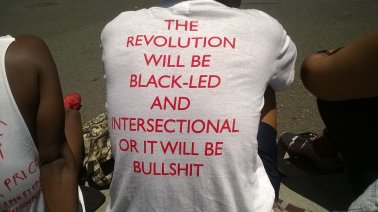
‘The revolution will be intersectional or it will be bullsh*t’

This is a phrase associated with the 2015 #feesmustfall and #rhodesmustfall movements: South African students are fighting for the right to a free education and decolonisation of the university system.

They are also fighting against the legacies of apartheid and colonisation that has left us one of the most unequal societies in the world, with the poor predominantly black, and the privileged predominantly white. They are fighting for societal transformation.

Last year the successes achieved by these movements reverberated around the world, and they continue to provoke and challenge South Africans in the early months of 2016

.CTXXCSLVEAErLYD.jpg_large

There is much that is fascinating about the student movements. But one of the things that captures my attention as a complexity scholar is their insistence on intersectionality. I’ve no doubt my understanding of this is still limited, but here’s a try: it is that the objectives of the revolution are multiple, and can only be realised together. Not only fees must fall, but also colonialism, unfair labour practices, gender inequality, prejudice and privilege and exclusion in any form.   True to a complexity perspective, nothing is separable in a complex dynamic system, even in its conception.

I’ve argued elsewhere that the climate mitigation policy community of practice continues to conceive of climate mitigation as separate to ‘development’, despite our acknowledgement that both require addressing, and that ‘development’ needs are paramount.

What can we learn from #feesmustfall?

Right now, I have a question for the students, excruciatingly aware of my position as a white, older, privileged member of our society, a member of a highly educated elite: how can my policy community of practice speak into your revolution? For as I see it climate change, both mitigation and impacts, in South Africa, are absolutely inseparable from the other issues you have identified.   Transformation of our society to one that is low carbon and just is a national policy objective, but one which we are far from understanding how to achieve.

Perhaps because of who we are as individuals, and as a policy collective, we have not yet been able to understand what is needed in order to connect with the objectives of powerful systems transformation movements such as yours.

But I’m wondering, with humility, whether intersectionality as a concept might be something we can work with.

A complexity view on ‘pledge and review’ vs ‘targets and timeframes’

I recently attended an event hosted by the African Climate and Development Initiative (University of Cape Town), reporting back on December’s Paris COP. An eminent local panel spoke of the significant shift which the Paris agreement embodied: after attempting for decades to achieve a deal based on ‘targets and timeframes’ under the UNFCCC, the Paris agreement is based on a ‘pledge and review’ system.

What is the difference? Setting targets and timeframes for climate change mitigation is a top-down exercise. A global emissions limit is agreed and apportioned to individual countries, together with timeframes for achieving this.  A pledge and review system is primarily bottom-up. Countries identify what they think they can achieve in the form of a pledge, and these pledges are periodically reviewed against what is possible and fair at the country level, and globally against environmental adequacy.

There was a sense that the panel members found the move to a ‘pledge and review’ world sub-optimal and disappointing, if not downright disastrous for the planet. The primarily rationale for this view is that there is no centralised control over total global emissions. One speaker recalled how Japan suggested a pledge and review approach 1991, only to be rejected out of hand because the idea appeared so clearly inadequate to the problem.

But a view from complexity thinking suggests that there might be something different happening here.   In 1991 the world was still dominated by the twentieth century belief that humans are in control. From this worldview it is no wonder that pledge and review appears sub-optimal. But in 2016 we’ve largely conceded control as a mirage.circular complexity

The world, and the challenge of climate mitigation in particular, is a complex systemic problem. A complex system is not centrally controlled, and the complexity policy literature suggests that top down targets and timeframes are therefore not particularly effective as policy responses.

So instead of ‘disastrously’ conceding to political reality, are we not perhaps finally adopting a policy paradigm that provides a better fit with the problem? This does not mean that it is automatically an adequate approach, just that it might a better one. As the panelists noted, the work has just begun.  And as complexity thinking emphasises, it requires collective responsibility. It is up to cities, communities and citizens to ensure adequacy.

Post Paris: On ‘what’, ‘how’, and ‘who’

Having worked from within the small climate change mitigation community of practice in South Africa for many years, I was recently made aware both that we are just that (a small community of practice with particular approaches and norms), and that we have a particular entry point to the issue of ‘development’.

These realisations, perhaps obvious to others, came to me when a group of development practitioners were invited to respond to our discourse at a 2014 MAPS Programme conference on development and climate mitigation in Cape Town.

The climate mitigation perspective on development focuses on linear pathways, technical possibilities and development indicators, the ‘what’. The development experts spoke of different things, of hearts and people and irrationality and politics and messiness. Perhaps more of the ‘how’ and the ‘who’?

531865-rags-and-richesThe milestone Paris Agreement may well be the turning point that those working on climate change have sought for so long.

So what does it mean for our on-going work on climate mitigation policy in development contexts? Seeking a coherent framework that can embrace the strengths of the climate mitigation community’s dominant approaches within a broader conceptualisation of the development context sent me off on my PhD journey, where I’ve been encountering complex dynamic systems thinking, transdisciplinarity and a lot of philosophy!

More on these as this blog evolves.  But for this post, what strikes me in relation to the question of ‘where to after Paris’, is that perhaps we need to actively look at ‘how we do what we do’ particularly given this sea change in the international policy environment.

Perhaps the objective now is less to identify ‘what’ individual countries can and should do, but rather to focus very closely on doing it. And this takes us firmly into the present, the ‘how’ and the ‘who’.